ULTRATHINK
Solutions
AI Application Architecture

The Bottleneck Isn't the Model. It's the Second Stack.

AI applications are software — but they require a second operating layer that most teams spend 12-18 months building from scratch. We bring a 13-layer reference architecture and ship a production-shaped slice with governance built in.

Of AI pilots fail to reach production (MIT)
95%
Typical foundation work before first use case ships
12-18mo
External implementation success rate vs. internal (MIT)
2x

The Model Works. The Infrastructure Around It Doesn't.

Most teams over-invest in model selection and under-invest in everything between the model and production: routing, orchestration, evals, policy gates, and observability. Those middle layers are where 95% of the engineering work lives — and where most teams have nothing.

The Missing Middle Layers

Teams pick a model and build a UI. Production requires model routing, durable orchestration, retrieval pipelines, eval harnesses, and policy gates. These middle layers are where systems live or die — and most organizations skip them entirely.

Ultrathink, "The Modern AI Application Stack"

Platform Fragmentation

Three teams at the same company solving retrieval three different ways. No shared primitives, no reuse, no governance. Every team invents its own RAG pipeline, prompt management, and evaluation approach — then wonders why nothing scales.

MIT NANDA, "The GenAI Divide," 2025

Governance Designed In, Not Bolted On

Security and compliance introduced after the architecture is set forces costly rework — or blocks production entirely. Governance tiering (Tier 0-3) and policy gates must be structural decisions from day one, not a last-minute audit.

Ultrathink, "The AI Program Lifecycle"

What We Deliver

We don't sell a platform license. We work with your architecture team to define the target state, ship a production-shaped thin slice to prove it works, then hand you the blueprint to scale independently.

13-Layer Reference Architecture

A complete blueprint covering Foundation, Core Services, Intelligence, and Governance layers — with buy, build, or partner guidance for each. Not a slide deck. An architecture your team can execute against.

13
Layers from infrastructure to governance
4
Governance tiers with policy gates at each
Learn more

Production Wedge Delivery

One use case, delivered as a thin vertical slice across the real stack — with eval harness, observability, governance tiering, and policy gates. Production-shaped, not demo-shaped.

6 wk
Production-shaped slice (Pathfinder™)
8 wk
Full production wedge (Outcome Partnership)
Learn more

Model Efficacy Audit

A comparative engineering stress-test benchmarking candidate models on latency, cost, compliance, and task fit against your actual workflow. Architecture decisions backed by data, not hype.

4+
Benchmark axes per use case
2+
Models recommended: primary + fallback
Learn more

The 13 Layers in a Production Deployment

This is what the reference architecture looks like when it ships — not a slide deck, but a real system with defined layers, technology choices, and integration points.
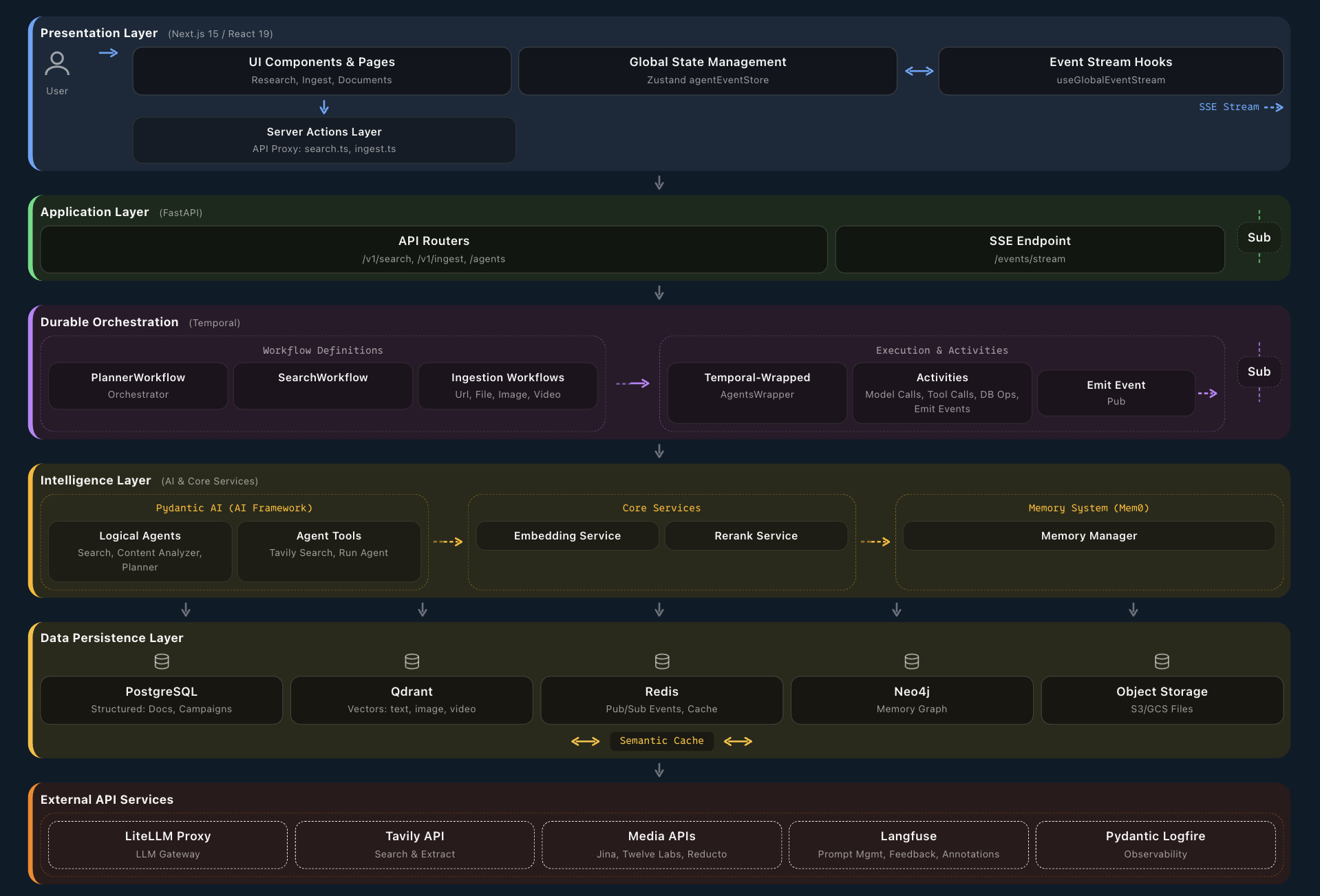
Ultrathink reference architecture diagram showing Presentation Layer, Application Layer, Durable Orchestration, Intelligence Layer, Data Persistence Layer, and External API Services

Reference architecture built on Ultrathink Axon™ — read the full whitepaper for buy/build guidance across all 13 layers.

The Synapse Cycle™ for Platform Teams

Our methodology adapted for the architecture buyer. Four phases from current-state audit to a production-shaped slice your team can point to.

1

Discovery + API™ Scoring

Map your current stack, AI maturity, and use case portfolio. Score candidates with the Action Potential Index™ to prioritize the highest-probability bet.

2

Architecture + Model Audit

Define the 13-layer target architecture. Benchmark model and infrastructure choices on latency, cost, compliance, and task fit.

3

Production-Shaped Slice

Ship one use case with governance tiering (Tier 0-3), eval harness, observability, and policy gates. Production-shaped, not demo-shaped.

4

Platform Blueprint

Reference architecture, shared primitives, governance framework, and operating model — so your team delivers the next 10 use cases independently.

Frequently Asked Questions

What is the modern AI application stack?

A 13-layer reference architecture spanning four groups: Foundation (infrastructure, models, data), Core Services (memory, tools, orchestration, model gateway), Intelligence (safety, prompts, evals, experimentation), and Governance (security, compliance, observability). Most teams build layers 1-2 and skip to layer 13, then wonder why production is hard. The answer is layers 3-12 — the missing middle where production systems live or die. Read the full architecture breakdown.

Why do most enterprise AI pilots fail to reach production?

Not because the model doesn't work — it does. MIT research found that 95% of enterprise AI pilots fail to reach production and only 5% of workflow-integrated systems deliver value. The root cause is missing infrastructure: no model routing, no durable orchestration, no eval harness, no governance tiering. Teams build a demo, skip the middle 10 layers, and then can't ship. This is the Execution Gap we close.

How long does a production AI architecture engagement take?

The Pathfinder Engagement™ delivers a reference architecture, governance design, and production-shaped thin slice in 4-6 weeks. The full production wedge — one use case running in production with SLOs, monitoring, and on-call — ships in 8 weeks from kickoff through the Outcome Partnership. Your team owns the platform blueprint either way.

What is a Model Efficacy Audit?

A comparative engineering stress-test that benchmarks candidate AI models against the specific requirements of a validated use case. The full audit is tailored to each engagement, but always covers latency vs. reasoning depth, cost profile at production scale, security and compliance constraints, and task fit against your actual workflow data — among other dimensions specific to your stack and risk profile. The output is a portfolio recommendation — primary model plus fallback — backed by engineering data, not marketing benchmarks. Read more about the Model Efficacy Audit.

Should we build or buy our AI platform?

Neither — at least not as a binary. The practical question is which layers to own, which to source, and which to partner on. Own the layers where competitive advantage lives (domain-specific tooling, proprietary data pipelines, custom evaluation). Source commoditized layers (model hosting, vector databases, observability tooling). Partner on the integration and governance that ties it together. We map this decision across all 13 layers during the Pathfinder. Read our Build vs. Buy analysis.

Stop Building the Foundation. Start Shipping Production AI.

Start with a Pathfinder Engagement — a fixed-scope, 4-6 week project that delivers a reference architecture, governance design, and production-shaped slice. You own the blueprint. No lock-in.